Friday, September 24, 2021

End of Garden Season Report


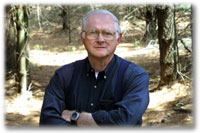
  Steve with struggling pumpkins.  Jerry Apps Photo.

The vegetable garden year at Roshara has ended.  And what a year it has been.  Everything was planted on time: potatoes, onions, lettuce, spinach, kale, radishes, carrots and beets on April 25.  Sweet corn, pumpkins, winter squash, zucchini, cucumbers, cabbage plants, kohlrabi, gourds and tomatoes on May 23.

Although we had periods of dry weather and periods of too much rain, everything came up and was growing well.  Steve put up the fence to keep out the deer, wild turkeys and raccoons. One of our best-looking gardens.  And then it happened.  The rabbits invaded.  Many of them. All hungry.  They ate everything but the tomatoes, potatoes and vine crops.  Ate the beans, lettuce, kale, beets, and cabbage right down to the ground. Hungry little buggers.  In my more than 50 years of vegetable gardening, I had never seen anything like it.  Nothing close.

So, my end of year garden report is a bit thin. Here are the grades:  Potatoes--A—good yield.  No scab.  Blight held off until the potatoes were ready for harvest.  Tomatoes--B—Quite good. Some blight. Sweet corn—C. Winter Squash—D, really never got going. Pumpkins—C.  Harvested several little decorative pumpkins.  Halloween size pumpkins struggled.  Cucumbers—A. Did well; harvested a bunch. Carrots—C. Rabbits don’t like carrots.   Don’t laugh, but by far the most successful crop was the zucchini.  It grew and grew, and produced more than anything else in the garden. A+ for the zucchini.  Of course, the old saying holds, if you can’t grow anything else, you can probably grow zucchini.

Anyone have a suggestion for keeping those hungry little cotton tails out of my garden next year?

THE OLD TIMER SAYS: Just when you think you’ve got everything figured out—you don’t.  Gardening is like that.

UPCOMING EVENTS

October 2, Dregne’s, Westby.  Book signing. 10:30 -2:30.


WHERE TO BUY MY BOOKS:

My newest novel is Settlers Valley.  You can buy it at your local bookstore, order online from bookshop.org, or purchase from the Friends of the Patterson Memorial Library in Wild Rose—a fundraiser for them. Phone: 920-622-3835 for prices and ordering.
Patterson Memorial Library
500 Division Street
Wild Rose, WI 54984
barnard@wildroselibrary.
www.wildroselibrary.org

If you live in the western part of the state, stop at Ruth’s home town, Westby and visit Dregne’s.  and look at their great selection of my books, including my new ones, or order a book by calling them at 1-877-634-4414. They will be happy to help you.


Friday, September 17, 2021

The Pond at Roshara


                                                                Steve Apps Photo

When we bought our farm in 1966, the pond in the valley to the west of the buildings could best be described as a large puddle in a good-sized marsh.  Slowly the water level increased.  By 1973-1975, the pond was filled to its banks.  It was a place for swimming and canoeing, a place for bird watching, and animal gazing as deer, racoons, fox and other wild creatures came to the pond for a drink, especially during the often hot and dry days of mid-summer.

               The pond has no inlet nor outlet, it’s a water table pond.  As the water table in the region goes up and down, so does our pond.  By the early 2000s, the pond level returned to about where it was in 1966, when we bought the place.  We wondered if it would ever return to the level it had been in the 1970s.

               Starting in about 2018, the rains became coming.  Fifteen inches of rain in 10 days in August of that year.  Once more the pond began looking like its former self.  By 2020 the pond was higher than it had ever been in recent memory.  Spilling over the banks of its once high point.  Surrounding trees on the  banks, oaks, aspen, cottonwood—and eventually killing them.  Killing cottonwood trees that were likely more than a hundred years old.

               This year, the pond, best described as a small lake, remains high as the rains continue to fall in central Wisconsin.  Seven inches in a couple weeks.  All the wild creatures love it—the pair of Canada geese that nest there and the sandhill cranes that nest there every summer.   How long will it remain a small lake?  One of the mysteries of nature that I find so interesting.

THE OLD TIMER SAYS: Ponds, like so many things in nature, are filled with surprises.


WHERE TO BUY MY BOOKS:

Want to learn more about the importance of rain to farmers.  Pick up a copy of my book, NEVER CURSE THE RAIN.  You can buy it at your local bookstore, order online from bookshop.org, or purchase from the Friends of the Patterson Memorial Library in Wild Rose—a fundraiser for them. Phone: 920-622-3835 for prices and ordering.
Patterson Memorial Library
500 Division Street
Wild Rose, WI 54984
barnard@wildroselibrary.
www.wildroselibrary.org

If you live in the western part of the state, stop at Ruth’s home town, Westby and visit Dregne’s.  and look at their great selection of my books, including my new ones, or order a book by calling them at 1-877-634-4414. They will be happy to help you.


Friday, September 10, 2021

Sunflowers Brighten a Day


             Photo by Steve Apps

My dad, a lifelong vegetable gardener, said a garden must always have something that’s pretty.  By that he meant it should include some flowers.  His favorite flowers were dahlias. He always grew a short row of them.  When they were both in their 90s, and my mother was in a nursing home, he would always take a big dahlia from his garden when he went to visit her.

I have followed his advice by growing some flowers in my garden. I grow sunflowers as they are one of my favorites.  As someone once wrote, “No flower can lift someone’s spirits quite like sunflowers.  They are bright and cheery, and as warm and inviting as the sweet summer sun.”

Sunflowers have a long history in the Americas.  In addition to their beauty, they were a food and medicine source for native people.  They crushed and ground the seeds and made bread and cakes from the resulting flour.  They used the juice from the stems to treat wounds.

The sunflower’s name comes from its tendency to face the sun. There are two main types, one grown for its oil, and other, with larger seeds for human and bird feed.  Sunflower oil can be used for cooking, and it is also found in some beauty products. Birds love sunflower seeds

But beyond the practical uses for their seeds.  Sunflowers are valuable in other ways.  They symbolize vitality, intelligence and happiness. Their yellow color symbolizes friendship.  As Helen Keller once wrote: “Keep your face to the sunshine and you cannot see the shadows.  It's what sunflowers do.”

THE OLD TIMER SAYS: Want to cheer up a friend; give them a sunflower.

WHERE TO BUY MY BOOKS:

To learn more about vegetable gardening, purchase a copy of Garden Wisdom.  You can buy it at your local bookstore, order online from bookshop.org, or purchase from the Friends of the Patterson Memorial Library in Wild Rose—a fundraiser for them. Phone: 920-622-3835 for prices and ordering.
Patterson Memorial Library
500 Division Street
Wild Rose, WI 54984
barnard@wildroselibrary.
www.wildroselibrary.org

If you live in the western part of the state, stop at Ruth’s home town, Westby and visit Dregne’s.  and look at their great selection of my books, including my new ones, or order a book by calling them at 1-877-634-4414. They will be happy to help you.

Friday, September 03, 2021

Memories of the Windmill


     Photo by Steve Apps

For many years, on the home farm, a windmill pumped water for our small herd of dairy cattle, for the horses, hogs, chickens, and for the family.  It was an all-metal Aermotor windmill.  Some earlier windmills were of wooden construction.  In 1883, LaVerne Noyes, a Chicago manufacturer hired a mechanical engineer by the name of Thomas O. Perry, who was a mechanical and civil engineer.  Perry experimented with 61 different “experimental wind wheels” before he settled on what became the Aermotor windmill.

The Aermotor windmill was introduced in 1888, and only 45 were sold that first year.  In 1892, the company sold 20,000 windmills.  Soon the Aermotor Company became a dominant supplier of windmills in the world.    At one time the company’s manufacturing operations covered nine acres on the southwest side of Chicago.   In 1915, the Aermotor company introduced an “auto-oiled” windmill, with an enclosed gearcase.  All the moving parts were bathed in oil, and had to be serviced but once a year.

The Aermotor windmill had one serious problem, however.  When the wind didn’t blow, there was no water.  I remember one time in the late 1930s when central Wisconsin was suffering from a serve drought. As long as our livestock had water, and some feed we could get by.  But then one day the wind quit blowing and the windmill quit turning.  Soon the stock tank for the livestock was empty, as was the water pail in the kitchen that provided water for the family.

We heard the cattle bellowing for water.  Not a pleasant sound.  All-day and all night they bellowed, as we waited for the wind to blow.  A neighbor, who powered his water pump with a gasoline engine. came to the rescue.  We hauled water from his farm, and not long after, dad bought a gasoline engine for our water pump.       

THE OLD TIMER SAYS: Wind power is wonderful, as long as the wind blows.

WHERE TO BUY MY BOOKS:

To learn more about early farming history, purchase a copy of Wisconsin Agriculture: A History.  You can buy it at your local bookstore, order online from bookshop.org, or purchase from the Friends of the Patterson Memorial Library in Wild Rose—a fundraiser for them. Phone: 920-622-3835 for prices and ordering.
Patterson Memorial Library
500 Division Street
Wild Rose, WI 54984
barnard@wildroselibrary.
www.wildroselibrary.org

Friday, August 27, 2021

Concord Grapes


  Photo by Steve Apps

Fifty years ago, I bought a Concord grape vine.  Just one.  I had put up a split rail fence around my yard and thought a grape vine growing on it might be a nice touch.  I knew absolutely nothing about growing grapes.  My only experience had been with wild grapes that grew on my farm, sometimes with vines that grew to the top of trees.

For the first couple of years, the vine sputtered along, growing a few feet and producing a small handful of grapes.  Each year it grew a bit more, working its way along the top rail of my fence.  One thing I learned was to heavily prune the vine each year, which I did.  To the point that one of my relatives said, “Looks like you killed your grape vine.”

But the pruning served the opposite purpose, the vine thrived.  It requires next to no care, beyond the annual pruning.  One year I had an influx of Japanese beetles, which chewed on the big leaves.  I picked the beetles off by hand, and little damage was done. My Concord grape vine likes hot weather.   This year it produced a bumper crop, more than half a bushel of beautiful purple grapes. 

Always curious, I did a bit of checking on the history of Concord grapes.  They got their start in New England when a fellow by the name of Ephraim Wales Bull collected some 20,000 wild grapes and grew them until he found the “perfect grape.” The year was 1854.  He named the grape after his is home town of Concord, Massachusetts.

For years Ruth has made grape jelly from our grapes—what a great peanut butter and jelly sandwich results from the grape jelly.  Grape juice is also tasty, and I’m told they also make a great wine, which I tried to make once.

THE OLD TIMER SAYS:  One lonely grape vine, mostly ignored, can surprise you with a bountiful harvest.

WHERE TO BUY MY BOOKS:

To purchase my books, go to your local bookstore, order online from bookshop.org, or purchase from the Friends of the Patterson Memorial Library in Wild Rose—a fundraiser for them. Phone: 920-622-3835 for prices and ordering.
Patterson Memorial Library
500 Division Street
Wild Rose, WI 54984
barnard@wildroselibrary.
www.wildroselibrary.org


Friday, August 20, 2021

The goldenrods are yellow


Photo by Jerry Apps 

Many will remember the poem, September, by Helen Hunt Jackson.  The first lines, “The goldenrod is yellow, the corn is turning brown, the trees in apple orchards with fruit are bending down.” The prairie at my farm is a field of yellow goldenrods everywhere.

 Someone said to me recently, when I shared a bit about my goldenrods and how beautiful they were, “You must not have any allergies, you know that goldenrods make you sneeze.”  I had to tell him he was wrong.  Goldenrods do not make you sneeze.  Ragweeds are often found near goldenrods and the pollen from them makes you sneeze, but not goldenrods.  I have no ragweeds in my prairie, so no sneezing when I work there.

Goldenrods are native to North America.  About 20 different species of this interesting wildflower grow in Wisconsin—8 to 10 species are fairly common.  The Canada Goldenrod or common golden rod is most often found in this state.    Besides being a rather beautiful wildflower, it will grow on good as well poor soil and require no care whatever.  Their pollen is enjoyed by bees and butterflies.  Goldenrods along with milkweed flowers are favorites for the endangered Monarch butterfly.

Considerable folklore is associated with the goldenrod flower.  Its Latin name is Solidago, which means whole, and is thought to be a reference to its possible healing powers. Native Americans used goldenrod as an herb to cure various illnesses including respiratory problems and wound healing.  Some people also believe that if you find goldenrods growing near your home, it is considered a sign of prosperity. 

Until I did a little research, I did not know about all the good things associated with goldenrods.  I mostly enjoy their beauty.

THE OLD TIMER SAYS: Be careful about accusing something as being bad, when it really is most beneficial.

WHERE TO BUY MY BOOKS:

To purchase my books, go to your local bookstore, order online from bookshop.org, or purchase from the Friends of the Patterson Memorial Library in Wild Rose—a fundraiser for them. Phone: 920-622-3835 for prices and ordering.
Patterson Memorial Library
500 Division Street
Wild Rose, WI 54984
barnard@wildroselibrary.
www.wildroselibrary.org

If you live in the western part of the state, stop at Ruth’s home town, Westby and visit Dregne’s.  and look at their great selection of my books, including my new ones, or order a book by calling them at 1-877-634-4414. They will be happy to help you.

Friday, August 13, 2021

Dog Days of Summer


Photo by Steve Apps

I remember as a kid, when our farm dog, Fanny, had a favorite place to rest during the hot, and humid days of late July and August. .If you wanted to find her, she usually was resting under the big elm tree that stood near our kitchen porch.

“Fanny seems to like that spot,” I said, stating the obvious. 

“Yup,” Pa would say.  “It’s the Dog Days of Summer.” 

The other day, when the temperature hit 92, and the air was so thick you could cut it with a knife, as my mother would say, I did a little digging to find more about the Dog Days of Summer. Where and when the phrase originated. To my surprise, originally the phrase had nothing to do with dogs. Ancient Greeks saw Sirius, a bright star they called the “dog star,” which this time of the year was a bright star that appeared to rise alongside the sun beginning in late July and continuing on through August.  According to these Greeks, the combined power of the “Dog Star” and the sun made this the hottest time of the year.

The truth of the matter.  The heat of summer has nothing to do with Sirius, the dog star, regardless of how bright it is. The Earth’s tilt is the cause of the heat of summer.  In the Northern Hemisphere, the Earth’s tilt causes the sun’s rays to hit at a more direct angle.  Also, the days are longer allowing more time for the sun to warm things up. Additionally, climate change is affecting the heat of summer as well, but that is a topic for another time.      


THE OLD TIMER SAYS:  The dogs have it right.  During the Dog Days of Summer, they know to find a cool place to rest.


WHERE TO BUY MY BOOKS:

To purchase my books, go to your local bookstore, order online from bookshop.org, or purchase from the Friends of the Patterson Memorial Library in Wild Rose—a fundraiser for them. Phone: 920-622-3835 for prices and ordering.
Patterson Memorial Library
500 Division Street
Wild Rose, WI 54984
barnard@wildroselibrary.
www.wildroselibrary.org

If you live in the western part of the state, stop at Ruth’s home town, Westby and visit Dregne’s.  and look at their great selection of my books, including my new ones, or order a book by calling them at 1-877-634-4414. They will be happy to help you.


 .

Friday, August 06, 2021

Let's Hear it for the Zucchini


Let’s Hear It for the Zucchini

Zucchini photo by Steve Apps


Mention zucchini and you usually evoke a smile.  Who hasn’t heard of wheelbarrow loads of zucchini summer squash?  Well, I hadn’t.  As a kid, we had about every vegetable possible in our big garden.  But no zucchini.  My guess is that Pa thought squash was something you harvested in the fall, and stored in the cellar for winter eating. I’m sure he and my mother couldn’t wrap their minds around eating squash in the summer.

When I began vegetable gardening at the farm I own now, friends suggested I must grow some zucchini.  “It is the thing to do,” these friends said, never as much as hinting about the reputation for this summer squash that I somehow had avoided.

So, I planted a long row of zucchini, and they grew and grew and soon covered their end of the garden with beautiful big yellow flowers, and then long and quickly growing longer cucumber-like, and nearly ax handle-long fruit. I carried an arm load of zucchini to the cabin, hoping that Ruth would know what to do with them.  She didn’t. We were soon nearly buried with zucchini, until Ruth discovered a recipe for zucchini bread, which, according to the grandkids, tastes better than cookies.

These days we grow just a few zucchini plants in our garden.  We have them more under control, mostly.   Ruth makes zucchini bread, Sue makes zucchini cake, Natasha makes zucchini cookies, and we enjoy the occasional casserole that has zucchini in it.

THE OLD TIMER SAYS:  What would a garden be without zucchini to talk about?

WHERE TO BUY MY BOOKS:

To purchase my books, go to your local bookstore, order online from bookshop.org, or purchase from the Friends of the Patterson Memorial Library in Wild Rose—a fundraiser for them. Phone: 920-622-3835 for prices and ordering.
Patterson Memorial Library
500 Division Street
Wild Rose, WI 54984
barnard@wildroselibrary.
www.wildroselibrary.org

If you live in the western part of the state, stop at Ruth’s home town, Westby and visit Dregne’s.  and look at their great selection of my books, including my new ones, or order a book by calling them at 1-877-634-4414. They will be happy to help you.


Friday, July 30, 2021

Let's Hear it for the Honey Bee


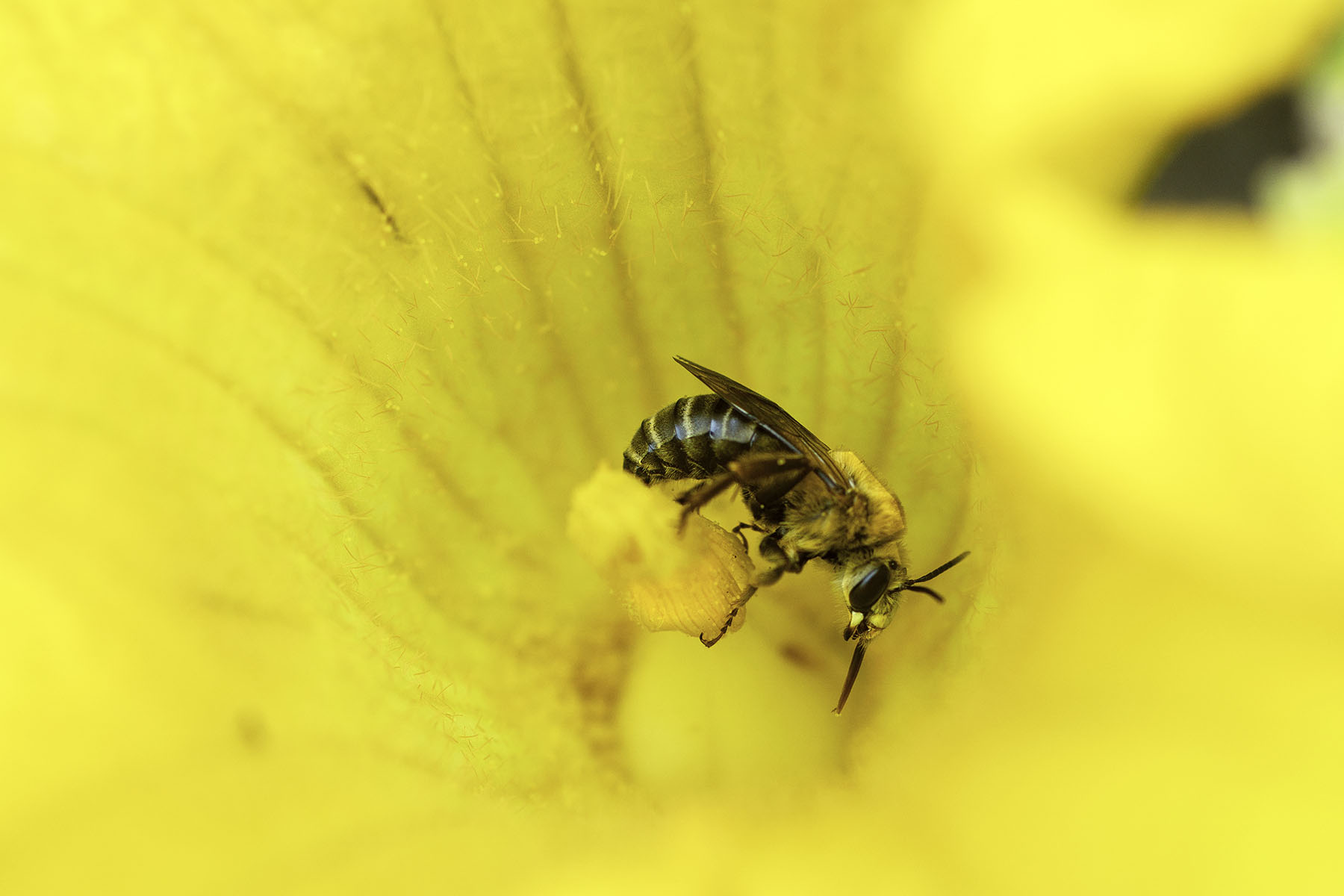
 Honey Bee on Zucchini Flower.  Photo by Steve Apps

 Honey bees.  Makers of honey.  Wonderful, sweet honey. Mostly ignored by most of the population. Despised by some—they sting you, don’t they?  But honey bees, along with all the other bees that flit around, are essential, not only for the honey they make but for their role as pollinators.  Some 75 percent of North American plant species require an insect, mostly bees, for pollination.  These include

.

fruit crops such as apples and cranberries, as well as many vegetable crops.


For several years, my farm garden saw diminished yields of cucumbers, squash and pumpkins.  Two years ago, I harvested but a handful of squash and only one pumpkin.  Then last year, everything changed.  My vegetable yields were back to normal.  Why I wondered?  My neighbor had taken up beekeeping, and his honey bees were regularly visiting my vegetable garden.


Travel by an orchard and you’ll likely spot what looks like boxes piled on end. These are beehives used for pollination. Same if you ride by a cranberry bog, where honey bees are rented from a beekeeper to pollinate their crop.


Honey bees are not native to North America.  They came from Europe with the early settlers in the 1600s. Unfortunately, honey bees as well as many of the native bees, all essential pollinators, are in decline.  The use of insecticides to kill crop pests also kills bees.  Additionally, honey bees often face viruses and other diseases that can raise havoc with a beehive.


For me, I am more than pleased that my neighbor has beehives.  Having them nearby has surely helped my garden return to normal production.  And, on top of it all, my neighbor came over the other day with a jar of honey.


THE OLD TIMER SAYS: Let’s applaud the honey bee for all the hard work it does.


WHERE TO BUY MY BOOKS:

To purchase my books, go to your local bookstore, order online from bookshop.org, or purchase from the Friends of the Patterson Memorial Library in Wild Rose—a fundraiser for them. Phone: 920-622-3835 for prices and ordering.
Patterson Memorial Library
500 Division Street
Wild Rose, WI 54984
barnard@wildroselibrary.
www.wildroselibrary.org

If you live in the western part of the state, stop at Ruth’s home town, Westby and visit Dregne’s.  and look at their great selection of my books, including my new ones, or order a book by calling them at 1-877-634-4414. They will be happy to help you.

Friday, July 23, 2021

Kitchen Garden


    The kitchen garden in our backyard is small.  Only four feet by eight feet. Thirty-two square feet.  A whisper of a garden compared to the one we have at the farm, where the rows are 30 inches apart and each row is several times longer than the length of our kitchen garden.

            And yet, our little garden with no rows at all is outdoing itself.   Recently I wrote about how the rabbits have feasted on several vegetables at the farm garden.  As you will note from the photo, this little garden is three feet off the ground, plus a four-foot fence all around it.  It may happen, but it will take an Olympic-style rabbit to leap over this fence.

            What’s in this little garden?  Several pole bean plants, a half-dozen climbing cucumbers, a nice patch of lettuce, four tomato plants and a goodly bunch of zinnias.  My Dad always said each garden must have something pretty.

            As far as the yields so far—I’ve harvested five servings of leaf lettuce, and six servings of green beans.  The cherry tomatoes will be ready in a couple weeks, and within a week or so I will be picking my first cucumbers.  We cut zinnias to grace or kitchen table every other day or so.

The theory of our little kitchen garden is to make sure every square inch is producing something, and that horizontal is as important as vertical—meaning that vegetables such as pole beans and cucumbers can grow upward.  My pole beans have grown seven feet tall.  I have to reach well above my head to pick them.

If you have a sunny place, you can grow a kitchen garden—and have fresh vegetables handy throughout most of the summer.  A real treat to have fresh vegetables so close.

THE OLD TIMER SAYS: Vegetable gardens come in many sizes—so nearly everyone can grow one

 \

WHERE TO BUY MY BOOKS:

To purchase my books, go to your local bookstore, order online from bookshop.org, or purchase from the Friends of the Patterson Memorial Library in Wild Rose—a fundraiser for them. Phone: 920-622-3835 for prices and ordering.
Patterson Memorial Library
500 Division Street
Wild Rose, WI 54984
barnard@wildroselibrary.
www.wildroselibrary.org

If you live in the western part of the state, stop at Ruth’s home town, Westby and visit Dregne’s.  and look at their great selection of my books, including my new ones, or order a book by calling them at 1-877-634-4414. They will be happy to help you.

Friday, July 16, 2021

APPS FAMILY AT THE LAKE


                                                                            Photo by Jerry Apps

 In 2002, Ruth and I started a tradition that we continue to this day.  When the tradition began, I was teaching a writing workshop at the School of the Arts in Rhinelander.  We invited our grown kids and their spouses to spend the week with us at a cottage on Lake George.

We’ve continued the tradition, now gathering at Long Lake in the Waupaca Chain O’ Lakes. This year some 20 of us have come to the lake from Boston, San Diego, Minneapolis, Avon, Co, Gunnison, Co, and Madison.

Each evening is a special event: birthday, graduation, and anniversary celebrations.  And a creativity evening.  This year the creativity evening featured everyone sharing their own “Old Timer” saying.

Here are some of them:

            “We all must become more comfortable with being uncomfortable”—Christian

            “In these turbulent times, five letters to remember: R-E-L-A-X”—Josh

            “I was addicted to the ‘Hokey-pokey,’ but then I turned myself around,”—Nick

            “Of all that I do best, doing nothing is at the top of the list,”—Blake

            “Happiness takes time so don’t rush looking for it,”—Libby and Grace

            “The sun sets no matter if no one is watching,”—Ben and Alyssa

            “Everything is better at the Lake,”—Tyler (8 years old)

            “Prior proper planning prevents poor performance,”—Annika

            “Life is tricky so make sure you plan for some time at the lake,”—Sue

            “Behind every great man is a woman—rolling her eyes,”—Jeff

            “A tree’s strength comes not from how far its branches reach, but from how deep its roots grow,”—Shanna and Pat.

            “Darn, why did I come into this room?”—Natasha and Steve

            “Never curse the rain, unless you live in a tent,”—Sandy

             “A trip is measured in miles, but captured in memories,”—Shanna and Pat

THE OLD TIMER SAYS: SO MANY THOUGHTS; IN SO FEW WORDS.

WHERE TO BUY MY BOOKS:

To purchase my books, go to your local bookstore, order online from bookshop.org, or purchase from the Friends of the Patterson Memorial Library in Wild Rose—a fundraiser for them. Phone: 920-622-3835 for prices and ordering.
Patterson Memorial Library
500 Division Street
Wild Rose, WI 54984
barnard@wildroselibrary.
www.wildroselibrary.org

If you live in the western part of the state, stop at Ruth’s home town, Westby and visit Dregne’s.  and look at their great selection of my books, including my new ones, or order a book by calling them at 1-877-634-4414. They will be happy to help you.


Friday, July 09, 2021

Growing on the roots of the old


    The old maple tree had to come down. It was well over a hundred years old, and it had done well—providing a nesting site for birds over the years, shading our cabin, providing a cool spot for us to talk with friends who stopped by for a visit.

            It was really four trees in one, all growing from one trunk and one root system.  Each year the tree got a bit larger, and the largest trunk, maybe 80 feet tall, began leaning over our machine shed.  Reluctantly, I decided this old friend had to come down—the old maple had indeed become a family friend.  With the tree down, we had piles of firewood for our wood-burning cookstove.  We would be reminded of our old maple friend each time we carried firewood into the house.

            The removal of the tree left a big hole in the windbreak for the farmstead.  And no shade to protect the cabin on hot summer days.  But then this spring, I noticed something unusual on the massive maple stump that remained.  At first it looked like a leaf of some kind had landed on the stump.

But it was not a leaf.  It was a little maple tree.  What a surprise.  The little tree, now several inches tall was growing rapidly.  It reminded me of a family.  When the grandparents pass, the children and the grandchildren live on.  Growing on the roots that the grandparents provided.  This little maple has a massive root system to grow on.  I look forward to seeing it grow.

THE OLD TIMER SAYS:  Many living creatures grow on the roots of their ancestors,


WHERE TO BUY MY BOOKS:

To purchase my books, go to your local bookstore, order online from bookshop.org, or purchase from the Friends of the Patterson Memorial Library in Wild Rose—a fundraiser for them. Phone: 920-622-3835 for prices and ordering.
Patterson Memorial Library
500 Division Street
Wild Rose, WI 54984
barnard@wildroselibrary.
www.wildroselibrary.org

If you live in the western part of the state, stop at Ruth’s home town, Westby and visit Dregne’s.  and look at their great selection of my books, including my new ones, or order a book by calling them at 1-877-634-4414. They will be happy to help you.


.


Friday, July 02, 2021

Fourth of July Garden Report


As I have done for several years, I report on my vegetable garden about the Fourth of July.  Each vegetable gets a rating from 1-10, with 10 being outstanding.  I report on the good and the bad, including this year, a few zeros.

Every gardening year has its challenges and this year is no exception.  The two most challenging features of our Waushara County Garden each year are the weather and critters.  First the weather.  The season began rather normal but in May quickly turned to hot and dry.  Except for some timely watering, we would not have had a garden.  Then, in mid-June the rains began coming, some five inches in a couple weeks.  Vegetables that love hot and wet weather took off, cool weather crops struggled a bit.

            The critter story is a sad one.  Our two-wire electric fence keeps out the deer, turkeys, and raccoons.  But not the rabbits.  This year the rabbit population is greater than we’ve known for twenty or more years, and with dry, hot weather, their normal grasses dried up. They attacked some of the garden vegetables.  And they destroyed them.  These are the vegetables that received a zero in Natasha's rating.

             Natasha, my daughter-in-law, and our chief veggie gardener rated the vegetables as of the Fourth of July as follows.  No vegetable received a 10. Sweet corn and potatoes--9.  Cucumbers, radishes, zucchini,  and winter squash--8.  Pumpkins, tomatoes, gourds, and sunflowers--7.  No vegetables for 6.  Beans--5.  Carrots--4.  None for 3.   Lettuce--2.   Green cabbage--1.  red cabbage, kohlrabi, kale, and spinach (rabbit food)--0.  Zero for onions as well, as the onion sets didn’t grow.

THE OLD TIMER SAYS: Every garden year has its ups and downs.


WHERE TO BUY MY BOOKS:

To purchase my books, go to your local bookstore, order online from bookshop.org, or purchase from the Friends of the Patterson Memorial Library in Wild Rose—a fundraiser for them. Phone: 920-622-3835 for prices and ordering.
Patterson Memorial Library
500 Division Street
Wild Rose, WI 54984
barnard@wildroselibrary.
www.wildroselibrary.org

If you live in the western part of the state, stop at Ruth’s home town, Westby and visit Dregne’s.  and look at their great selection of my books, including my new ones, or order a book by calling them at 1-877-634-4414. They will be happy to help you.


Friday, June 25, 2021

June, a Special Month


Strawberry pie photo by Steve Apps

June. A very special month. Let’s start with it being Dairy Month in Wisconsin.  A chance to applaud the hardworking farmers and cheesemakers that keep Wisconsin the number one cheesemaking state in the nation.  Wisconsin has been number one since 1910 when our cheesemakers took the title away from New York State, which had been the nation’s top dairy state. So many great cheese varieties to try—some 600 of them.  Which is most popular these days?  Cheddar?  Nope, it’s Mozzarella. This country likes its pizza and Mozzarella is a prime ingredient.

June has the longest day of the year, the most daylight hours of any of the months.  And it also marks the beginning of summer—officially.

June is the month of fresh peas, lettuce and radishes from the garden.  Nothing tastes better than vegetables that have been freshly harvested..

For this old farm boy, June was also haymaking month.  I will never forget the smell of freshly cut and curing alfalfa—no perfume comes close.

But of all the memories, one sneaks up on top.  Strawberries.  We had a sizeable patch of them—they were my mother’s project.  We picked them and sold them to friends, relatives, and traded for groceries with them at the Mercantile store in Wild Rose.  And we ate them three times a day.  On our cornflakes at breakfast, on shortcake for lunch, and if we were lucky, in a strawberry pie for supper.  My mother also canned strawberries—no freezing as we didn’t have electricity. We enjoyed them all winter long.  When unexpected company came, she brought up from a cellar a jar of canned strawberries.  Always a treat for our city relatives.

THE OLD TIMER SAYS: June, a special month in many ways.


WHERE TO BUY MY BOOKS:

To purchase my books, go to your local bookstore, order online from bookshop.org, or purchase from the Friends of the Patterson Memorial Library in Wild Rose—a fundraiser for them. Phone: 920-622-3835 for prices and ordering.
Patterson Memorial Library
500 Division Street
Wild Rose, WI 54984
barnard@wildroselibrary.
www.wildroselibrary.org

If you live in the western part of the state, stop at Ruth’s home town, Westby and visit Dregne’s.  and look at their great selection of my books, including my new ones, or order a book by calling them at 1-877-634-4414. They will be happy to help you.